Editor’s note
Late last August, as Journal staff were in the late stages of preparing the October issue, I received an email from a young Anglican named Jess Tunggal. They (Tunggal prefers non-gendered pronouns) wanted to write an opinion piece based on their experience coming to Christ—a journey in which witchcraft, they said, had played a vital role. Tunggal told me they had moved on from neopaganism but, at the same time, felt some of the ideas they had found there had, in the end, served to deepen their Christian faith. I was intrigued by the proposal, and said I’d consider their piece for publication.
I found Tunggal’s column original and stimulating. I was struck by the earnestness with which they described their spiritual quest, and I was reminded of the many ways throughout its history that Christianity has been enlightened by its encounters with the other. And so I decided to publish it. It appeared in our November issue (“Three things witchcraft taught me about God,” p.4) and online in October.
Could I have brought to this decision more awareness of the dangers that some occult beliefs pose to vulnerable people, and should I have considered the many biblical injunctions against witchcraft? Probably, but I was also mindful of the fact that, as Tunggal stated in their column, witchcraft was something from which they had now moved on; the point of their piece was not to draw readers from Christianity to the occult but to spur dialogue and reflection. (I was also mindful of the Journal’s mandate, given to it by General Synod, to provide “a forum for the full range of voices and views across the Church.”)
The piece generated controversy as soon as it was published; within 24 hours of its appearance on anglicanjournal.com, I had received a small number of emails intensely critical of the piece and my decision to publish it. Three of those who were unhappy about the piece—about half the total—were past or present bishops. (It’s unusual for me to hear from bishops on Anglican Journal content.) People felt theJournal should not be promoting beliefs and practices condemned by the Bible and that, in their opinion, were often dangerous. Some asked that the article be pulled. There was controversy over the article on social media as well. Not all the response was critical; some praised the article, both online and in correspondence to me. The January issue’s Letters section conveys something of this controversy (though all but two of those who were critical of the article asked that their emails not be published).
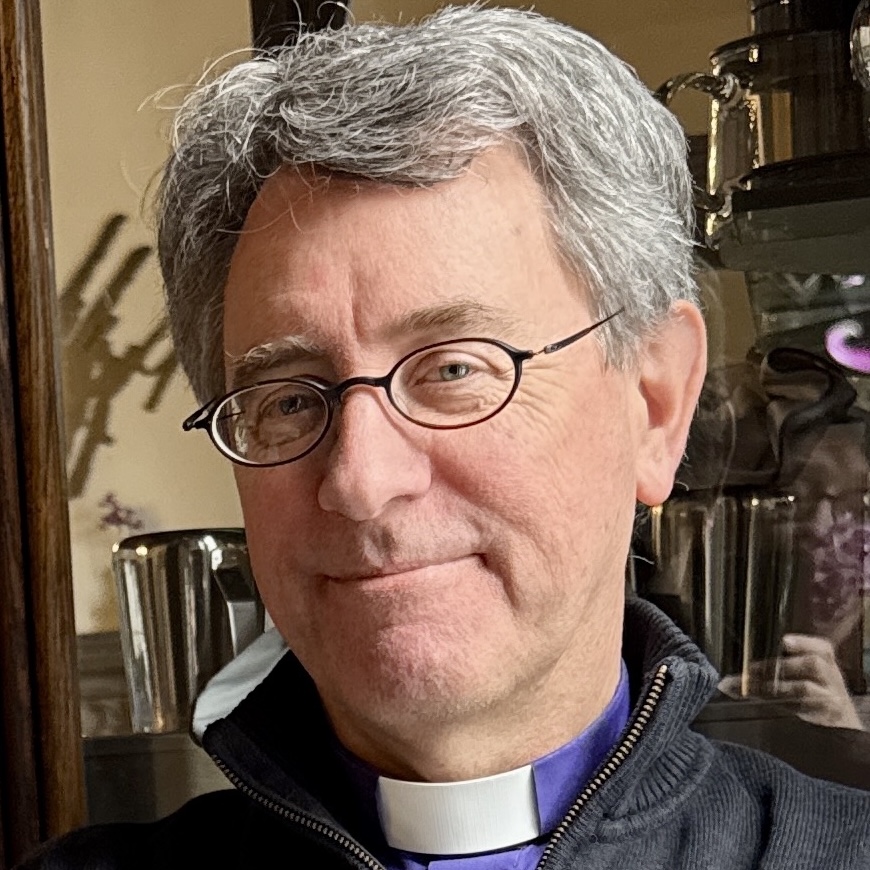
The Journal’s editorial board met to discern a response to this unusual situation, and decided on asking a respected Canadian Anglican theologian to comment on Tunggal’s column, with the purpose of clarifying, in a pastoral tone, traditional Anglican theology in response to the piece. The first name that came up was Bishop Stephen Andrews, principal of Wycliffe College until his retirement in June 2025. I was pleased that Andrews agreed. Here’s what he wrote for us.
Church history is a narrative of surprising conversions. In the earliest written strands, we have the dramatic “Damascus Road” experience of the violently zealous Saul where, by means of a supernatural, personal encounter with the risen Christ, he was transformed from a persecutor of the Christian way to a devoted adherent and apostle. Nineteen hundred years later that same Christ would appear to the young Hugh Montefiore, later bishop of Birmingham, who was raised in a family of devout and practicing Jews, and who had never attended a Christian service of worship. But once when he was in his school study, he wrote, in his 1995 autobiography:
“I suddenly became aware of a figure in white whom I saw clearly in my mind’s eye [. . . and] I heard the words ‘Follow me.’ Instinctively I knew that this was Jesus, heaven knows how: I knew nothing about him . . . It was an indescribably rich event that filled me afterwards with overpowering joy. I could do no other than to follow those instructions.” Such accounts remind us that Jesus continues to seek people in unexpected ways.
I begin my reflections in this vein because it was as a conversion narrative that I read the recent Anglican Journal opinion piece by Jess Tunggal entitled, “Three things witchcraft taught me about God” (published online Oct. 21, 2025). In this article, Jess claims to have found Jesus “in a spellbook.” It is an arresting way to begin an essay, and it stirred up some controversy on social media. But Jess assures me that the statement was a figure of speech, and much of the ensuing testimony both in the essay and in our subsequent conversation struck me as an account not so much of how Jess found Jesus, but of how Jesus found Jess.
On the surface of it, Jess’s narrative is not so unusual. A young person, disenchanted with the church, finds enchantment elsewhere. Where the church’s culture is exclusive and monolithic, a seeker is naturally drawn to a more inclusive, grace-filled community. Where the church’s worship is dull and perfunctory, the spiritually hungry are attracted to other offers of transcendence, sometimes through hallucinogenic means or, as in Jess’s case, through ritual. What I hope many might appreciate in Jess’s narrative is that somehow, in Jess’s quest for connection with the divine, Jesus revealed himself to Jess as the Incarnate Son of God, and the source of both love and salvation through his death on the cross. What makes Jess’s narrative surprising, though, is that Jess began to come to this realisation through an experience of witchcraft.
Some people found this narrative more alarming than surprising. And with some justification. For there is reason to be wary about the occult, as not all the supernatural forces at work in the world are intent on serving God. Indeed, the context of the biblical narrative from Genesis to Revelation is that there is a cosmic struggle underway, and the Bible condemns any attempt to engage pagan spirits: “Let no one be found among you who makes his son or daughter pass through fire, no augur or soothsayer or diviner or sorcerer, no one who casts spells or traffics with ghosts and spirits, and no necromancer. Those who do such things are abominable to the Lord” (Deuteronomy 18.10-12). It has been suggested that one of the reasons that the divine name (YHWH) is unpronounceable in Judaism is to prevent people from using it in incantations.
There is nevertheless evidence that practices of divination flourished in first-century Judaism. We read about Jewish sorcerers and exorcists in Acts 13 and 19, and among ancient Jewish artifacts are incantations, curses and amulets. These instruments were used to garner protection, alter fate or even seek revenge. But St. Paul pairs sorcery with idolatry in Galatians 5:20, indicating that the use of magic is in essence a denial of the sovereignty of God’s Spirit over all principalities and powers. The truth, he claims, is that Christ has rendered the cosmic powers impotent by his victory over them on the cross (Colossians 2.14- 15).
Of course, spiritual rebellion still takes place in the world. But God’s triumph over the elemental powers means that some of them may actually do his bidding. Indeed, it was through astrology that a group of magicians from “the East” were led to a manger in Bethlehem. So surely it is possible that through the magic arts and the worship of nature, God might draw people like Jess to a saving knowledge of God’s divine Son.
There was, in fact, a book published in the 18th century with the title, A Narrative of Surprising Conversions. It was written by the pastor and theologian Jonathan Edwards to describe the religious revival that happened in Northampton, Massachusetts in 1734. The revival began among the young people in the community, and their turn to God was occasioned by the deaths of a man “in the bloom of his youth” and of a young married woman. But what emerges in Edwards’ chronicle is the “surprise” that through these natural occurrences, and the faithful teaching of the Church, people would come to a deep conviction of their need for God and for the grace of forgiveness offered them in Jesus Christ. This is the same grace that we receive when we gather around the Lord’s table alongside those whom God continues to call in the most unexpected and extraordinary ways.