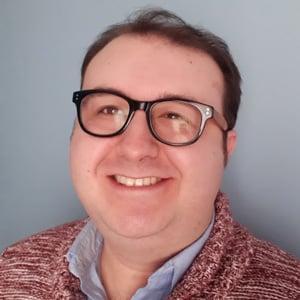
Archbishop Shane Parker says he’s committed to rapid change—even if means considering the suspension of canons
Born in Edmonton, Archbishop Shane Parker, elected primate of the Anglican Church of Canada June 26, is a former sociologist. He studied theology at Saint Paul University and in 1987 was ordained as a priest in the diocese of Ottawa, going on to serve as a parish priest and diocesan archdeacon. In 1999 Parker was appointed dean of Ottawa and rector of Christ Church Cathedral and in 2020 was elected the 10th bishop of Ottawa. He has served as a part-time professor of pastoral ministry and theology at Saint Paul University and chairs the seminary’s Anglican Studies Advisory Committee.
Parker sat down with the Journal July 18 for a wide-ranging conversation. This interview has been lightly edited.
How are you finding it so far?
Well, it’s been, as we do this interview, three weeks and 12 hours since I was elected and I’m very, very conscious of the prayerful support of the church. I feel like I’m standing on that platform. I do hold two positions. I’m the bishop of Ottawa and the primate of Anglican Church of Canada and I’m between cities right now. So it’s good in the sense that the rightness of this is becoming more evident to me.
So as most people know, this was not an easy discernment for me. And when I did relinquish and accept, I felt a sense of peace, rightness in a sense, that this is the right thing to be doing, you might say—and, as the days and weeks have passed, that sense of understanding the call, understanding why it happened, given how General Synod expressed itself. And as I come into this building and meet the very, very strong and committed senior staff, I see alignment happening all over the place—in terms of my own lifelong experiences and where our General Synod is, in terms of determining the need for major change, sensing a very strong willingness and desire on the part of senior staff to participate in that process of change. I see the alignments happening spiritually, episcopally and personally.
And I will, God willing, have a place to live here and will move here and be fully present. So if you have a lead on a good apartment … [laughs]
One of your speeches at General Synod used this imagery of removing insulation. I’m curious in practical terms how that has begun to take shape.
So first of all, I wouldn’t want that image to be carried much farther than what it was in the moment—an allusion to my earliest memories in the church. And it struck me we are at a time to look at what insulates us or prevents us from full communion with God, with the world around us, with each other.
I think going back to the notion of rightness and alignment, I can see that it has been expressed by General Synod that we need to undertake a programme of deep change. And that is cultural, it’s structural, it’s operational. And as I let the way God wired me open up into this, I can see where our core mission as a church is. I can see the core ethos of the Anglican Church of Canada and I can see some of the things that have built up around that over the years.
I can see the kernel of who we are and what we must be. And when I say “we” at this point, I’m talking about the national church. I’m not thinking, say, one specific diocese. The pathways were very clear that we are addressing in the first instance national structures and things related to that. The extent to which we’re calling for a restructuring of how our dioceses work and everything else is a separate question.
So when I look to our church at this time, our national church, and I look to where we have built up things around us in very faithful, well-intentioned intent to expand our mission, I see we have in some ways insulated ourselves from what is the core mission of Church House. What is the core mission? What is the convene, communicate, coordinate function that’s been identified? My belief is that Church House—and I’ll increasingly use that phrase to describe the office of General Synod; it’s a house with people and those people have names—those people have faith and commitment and help the church. So Church House is positioning itself to be a resource to our church. That’s a clear call. And the senior staff are extremely willing to engage. How do we do our work so that when people think of Church House, they say, yes, that’s of value to my diocese. It’s of value to me as a bishop, value to me as a priest, it’s of value to me in my parish. That’s where we need to go. So whatever is not achieving that right now has to be subjected to intense scrutiny about our vision I think we eliminate, we revise or we create, right? There’s three options as we move towards a place where Church House is serving all the dioceses, bishops, clergy and people of the Anglican Church of Canada
People are not that clear, I think, in their parishes about what goes on at Church House. What I keep hearing is, “Show me the value that that’s having to my local parish.”
It’s an excellent and apt question that has to be asked. Absolutely.
I’m in my 39th year of ordination. Most of those years were spent in parish ministry. I am acutely aware of how dioceses can sometimes be asked the same question: “What is the synod office doing for me? They take our money and I don’t know what the value is to us.” And something that I will insist on, push, promote, is language. It’s our church, it’s our national church, it’s our primate, our primate’s office. And to create that sense of not othering one another, we need to demonstrate that we are part of the same church.
It’s a national church organizing diocesan churches and we need to communicate first of all, refine, declare responsibly, shape what Church House is and does and then communicate ourselves not just from Church House out but also from our diocesan churches in. It’s us and ours and we are in relationship, and those relationships are built on mutual respect; we are clearly serving God in Christ and serving one another. And if we’re not, we can legitimately raise those questions. So part of what we need to do going forward is to conduct a major change process—faithfully live out the call of the pathways and then we need to live into that in a way that is evaluative and reflexive.
One of the things our military chaplains tell us is that the military is very good at analysing what it does and refining. After an operation, you go into, “What worked, what didn’t work, what do we need to do?” We need to adopt that kind of “what’s working” [approach] and be able to be flexible enough and healthy enough and mature enough to say, “That’s not working.” We need to shift it instead of allowing structures to crystallise over years, continuously tacking new things onto it, confusing staff. “Well what am I supposed to do about this legacy thing that’s been around here since the 60s that’s never really been substantially evaluated, or these new exciting things that are coming in?” We need to clarify that so the very talented people in Church House [can say], “I know what I’m doing and I know why I’m doing it. I know what it’s about.”
How are those decisions made about what is and isn’t working, procedurally speaking?
Yes, so I need to clarify where the decision rights lie, who has the authority to do what. That’s not completely clear to me. And in a point of generous criticism that should be abundantly clear to me coming in. That has become not confused but opaque. It’s hard to know. And this will often happen, especially when you have rotating senior leadership, and more of a permanent staff, and leaders come and go and leadership styles change. We tend to accord or afford to senior leaders more than those individuals actually have canonically and more than they want. But we do sort of elect monarchs and consecrate monarchs sometimes and that’s not on—a bishop is a servant leader.
Bishops in the first instance were the chief pastors who provided the sacraments to the church and when the church started getting bigger, they needed to get some help. So they appointed deacons and eventually presbyters and so on. That function of growth and the cultural changes tended to elevate the bishop up and away when in fact the bishop in the bishop’s cathedra—in his domus, his house, literally his family home—is now in a palace somewhere. Either literally or relationally. And we need to understand that leadership in the church is much more level than it is hierarchical, in fact.
The other part of that is when in a situation where there’s a large, not an appropriate term in our context, but when there’s a large volunteer constituency and then you have staff and then you have senior leaders coming and going, you can see how misalignment can happen quite quickly. One of the best practises in not-for-profit boards is to promote and generate interdependence between the volunteers and the staff. Basically, if one leads or the other leads, you’re going to get fragmentation happening. And we have a lot of committees, a lot of bodies. Our Church House staff are normally assigned to them. We need to examine: is there interdependence and is the mandate clear, is it still relevant and should the body even exist? It’s that deep analysis.
And then on a practical hour-to-hour basis, does that happen by means of having meetings with the officers of General Synod with the heads of departments? Is it going through large books of canon law?
Canon law is there as required and canon law is constructed inductively, it’s from experience and codified; it didn’t drop down [from the sky]. So we need to understand that canon law is a reflection of how our predecessors made decisions about things and we reference it, it has authority.
But in a time of great change, there needs to be a conscious recognition that we are suspending something, we will not observe that. Whether we can do that according to our canons is a question I don’t know the answer to. [Editor’s note: Asked later to explain his meaning here, Parker said a clearer rendering of his thoughts was, “But as we move through this time of great change,we may discover that we need to temporarily suspend some aspects of our canons to do the work at hand. Whether our canons allow us to do that is a question I don’t know the answer to.”]
But we need to be clear that in the next triennium we need to create provisional structures and relationships to drive this change. We have Church House, right? We have officers of General Synod, we have CoGS and there needs to be a provisional body created that’s focused entirely on the change.
What’s the $2 million [allocated by General Synod to pursue the pathways] for? It’s not to create more staff positions. Absolutely not. It’s to get the results we need to drive the change as clearly articulated in the six pathways.
And am I right in thinking that some of that happens at the constitutional convention that’s been planned for some time this triennium?
That’s one part of the broad spectrum. And I don’t have all my pathway numbers sorted out. So that’s exactly right. That constitutional convention is not [just] a bunch of really intelligent and faithful chancellors. It’s a sociological analysis. First of all, how does our church actually work now? How should it be working now? And what constitutional changes need to happen to enable that or to reflect that?
As you say, canon law is not dropped from the heavens.
How are we living, what are the patterns? “Yeah, that’s good”—we codify it. “That’s irregular. It’s a convention that’s crept in. It’s not actually good and healthy”—that needs to go, basically.
Is there any sense of when that might be?
I think it’s fair to say that my intention is to lead aggressively, assertively, intentionally to put in place the vehicles that are needed to drive change on the six routes articulated in the pathways. So that begins with creating the kind of provisional structure [in the] early days. But I’ve had discussions which begin to define what body [that will be], which of course is accountable and reports to CoGS [Council of General Synod]. It’s not simply the officers of General Synod. Is it convening some sort of council, is it a transition task force? Something needs to be put in place that’s constantly interacting with CoGS and all the bodies that are required, with essentially six pathway teams, let’s call them, which are focused first of all on understanding their terms of reference and secondly providing a timetable with clear deliverables and points of contact both with the body that oversees it and with CoGS. So that we will soon, I’m hoping early in the new year, we’ll have a clear, sometimes called a Gantt chart—”here’s all the stuff we’re supposed to be doing and here’s what we can expect.” Deliverables. We’ll have that over the six areas.
We’ll populate each of the teams, hire [temporary staff] as required to enable that work and in this triennium we’ll move forward achieving results as quickly and responsibly as possible with early wins wherever we can to demonstrate to the General Synod that we’re in business here. We’re in the business of conducting the change that has unambiguously been called for.
I think that’s exactly what I was looking for when I walked into this interview—to get as clear a picture as possible of how that would work and what people should be watching for in the coming times.
What you should be watching for in the first place are the engines, the engines that will drive change. We’re not talking permanent staffing, we’re not talking permanent structures. What car, what vehicle, what do we put in place? What human beings do we organise and convene in order to drive this?
At one point someone at General Synod mentioned the possibility of having an extra General Synod in order to make the necessary change happen faster.
So we will use whatever means we have to convene, to coordinate, to communicate this change process. I believe that we have a clear mandate which was derived from an iterative, carefully orchestrated commission, the primate’s commission, a lot of consultation that was tested. We can trust that the ultimate validation of that was at General Synod—its 90% whatever it was. [Editor’s note: A resolution that General Synod adopt the six pathways to change drafted by the primatial commission passed June 26 by 199 to 14 votes, or 93 per cent.]
That’s not to mention three or four listening processes. If there’s one thing we know, it’s what the Anglican Church of Canada’s members have said their values are on those surveys.
The principles are articulated. So we have means that we have never used that we can [now], but we have to set up an ongoing process where people understand that change is happening, it’s consistent with the heart of each of those pathways. Obviously those pathways do not contain an action plan in any kind of granular way. That’s the work of each, let’s called them, pathway team. How are you going to achieve that? What resources, what markers, what’s the actual process going to be to drive that? That’s to be determined. As people say, we need to operationalize these things, put them into action. So that as I said to CoGS, I intend to use the full extent of the authority of CoGS, the full extent of the authority of the office of General Synod and the full extent of the authority of the primate to make this happen. [Editor’s note: Parker met with the new members of CoGS after they had been chosen at General Synod.] Absolutely. And the full authority, it’s implied, of the senior staff at Church House. There is considerable authority to make changes in the names of departments and the staffing of departments and so on. And there’s a real sense in which action can happen quite quickly on the strength of the authority of the senior staff at Church House.
If the canons are be taken seriously where they say the primate is the president and CEO of the Office of General Synod, then they have the powers of a president and a CEO.
And I need to understand the full scope of that. And there will be times where the assumption will be the authority is there, whether it’s clearly articulated or not. The urgency of this is not lost on me or on the members of General Synod.
And sometimes you wait to see when you bump up against something and then that’s when you reevaluate what the course is?
Yep. And you know, addressing resistance is part of change; it’s not a bad thing. If there’s resistance, you see what’s there. And sometimes the resistance has a point and sometimes it feels God-led and more information can help address that. Sometimes [you have to say] “I’m sorry I can’t do anything about that.” But when I was teaching pastoral ministry and sociology, it was in many cases about change. It’s pastoral. Meeting resistance is a pastoral exercise. You go to those who have concerns and resistance, you listen as well as you can. You do whatever you can to address it by a “good idea” or “actually you’re basing your resistance on something that’s inaccurate” or “I hear you,” whether it’s a “sorry we’re not able to do anything for [that].” But you’re telling people that. You’re in relationship.
I was talking with Principal of Wycliffe College and retired Bishop Steven Andrews earlier this week. He mentioned he’d had a conversation with you about theological colleges and theological issues and he said that you’d shown some interest in approaching some of those issues. I wonder if you could speak to that for me. What I’m trying to do is open-endedly ask if there are any issues you’re interested in there.
So what I would say at this point, I wouldn’t be comfortable identifying issues. However, an approach to issues is something I’m comfortable talking about. We have, within the Anglican Church of Canada, scholars. We have people with PhDs who are teaching, we have subject experts who’ve gone on deep dives into things. We need to bring the voices of our theologians into our discourse as we address issues. The depth of understanding and knowledge that is there and often not called upon is something that needs to be [called on].
So through my own practice as bishop of Ottawa, I have brought in university professors to clergy conferences, subject experts. They’ve done a deep dive.
The American theologian, David Tracy, University of Chicago, talked about the three publics of theology—the public of the church, the public of the academy and the public of society. The church is often a public that is not receptive to, doesn’t invite, doesn’t engage with the work of theology, and that’s—theologians are critical thinkers. They help us think critically about important issues. They have knowledge, they have perspectives. My approach to issues would be, “Let’s bring in our theologians, to help us as one voice that is important to help frame things and inform our discussions.”
In the conversation on disability theology at General Synod someone— I think it was the Rev. Christopher Samsom from the diocese of Caledonia—stood up and raised a theological question. I see where that would be a time to have a theologian involved [for General Synod to consult on the spot].
The different aspects of theology, you have ecclesiology, systematic theology, moral theology—theology is not one big lump that lands down. And again, theologians are scholars, they study, but they also are teachers in many cases. And to have theological input is not to say, “Here’s the answer for you,” it’s, “Here’s how you think about this theologically, here’s how you bring in scripture, tradition, reason, the troika of the Anglican faith.” And often in our discourse around issues, we forget that it’s scripture, tradition, reason. I mean that’s the beginnings of Anglicanism.
Henri Nouwen once was interviewed about the purpose of theological education, and he said the purpose of theological education is to produce articulate not-knowers. Theological education is not about filling yourself up with stuff to dispense to the faithful the rest of your life. It’s learning how to think. It’s learning what you don’t know about the mystery of God. It’s helping people explore and engage the idea of God and so on. And I think we should perhaps nurture that idea that theologians and theological colleges are not repositories of information that they feed intravenously into theological students who go out and then dispense it. They’re active places of discernment, of exploration, of questing. And that’s a good thing. Theology is faith seeking understanding.
I’ve also got a couple of questions on other matters I’d be interested if you’d like to comment on. First, is there any idea when the investigation on the lease on 300 Bloor Street will be out?
The investigation is still ongoing. There has been some collection of information; I have not seen the results of that.
[Editor’s Note: In a follow-up email, the Anglican Journal asked whether the results of that investigation would be made public when they are available, to which Parker replied, “I am unable to answer that at this point. There is, of course, a duty to report back to GS in a responsible and timely manner, which will happen at some point.”]
Meanwhile, there has been this story going on about the controversial firing of a priest in the diocese Western Newfoundland. The most recent aspect is that Bishop John Organ, who fired Dean Catherine Short, has been provided a set of recommendations from the provincial metropolitan following a safe church complaint. And he has publicly declined to follow any of those. I realize the primate is not directly responsible for the discipline of bishops or clergy in general, but would you like to enter any comment on that situation?
So the primate is jurisdictionally constrained. My understanding of that situation is that the church process has run its course and resulted in what you just said, a group of recommendations that are not being followed, essentially. So I believe what this has become is a dispute between two children of God, Dean Short and Bishop Organ. The primate is not able jurisdictionally to go in and initiate any kind of formal church process at all. This is not a matter of canons being violated, not that that at all, but the primate is able to provide pastoral assistance. I have been in touch with both parties personally and directly. Both of them have consented to allow me to be an intermediary and that is what is happening.
What can you tell me about yourself outside of the role of primate and outside of the role of bishop that would help a reader get to know you?
My whole life has been outside the role of primate.
[Laughs] Well yeah, sure. Up to this point.
Yeah, so I’m a grandfather. I have three grandchildren. My two sons and their spouses have produced offspring. My oldest son is a professor at St. Michael’s College at the University of Toronto and his wife manages the produce section of Karma Food Cooperative here in Toronto and their daughter is 11. My second son, after a number of years working, has gone to university and he wishes to become an elementary school teacher and his partner works in the development department of the Royal Ontario Museum. So they’re both here and they have two children. My only grandson is three and my second granddaughter turned seven yesterday. So they’re here in Toronto. My daughter is a priest of the Anglican Diocese of Ottawa and I told her that the good news is that I’m not her bishop anymore. Bad news is that she has to call me “Your Grace.”
And she’s married to a fellow who is an employment lawyer.
So that’s my family. My wife Katherine is a family lawyer and mediator. She was for many years working principally in the area of litigation. She left that behind after a successful career; she was extremely accomplished and now she is providing principally mediation services. She’s a mentor with various law societies for younger lawyers and she does write a number of articles for journals based on her experience in the courts.
I am the child of Irish immigrants. My extended family of origin is still largely in Ireland I have been back to visit them every three or four years since 2000.
So personally I am someone who enjoys doing lots of different kinds of things and I pick things up quickly, especially if I want to. I’m quite handy. I’ve built log cabins, I’ve made furniture, renovated kitchens. I built a small addition to my daughter’s house last year. I really enjoy the combination of physical work, of solving problems practically, of finding solutions to them. And I love the contemplative nature of just being really busy with your hands because you’re not worrying about your troubles. You’re worrying about having 10 fingers at the end of the day. I enjoy being out of doors in lots of different ways. In Ireland and Scotland, I will go hill walking as it’s called, here we would call it hiking, spending long days, often solo, enjoying the coastal mountains in Scotland and Ireland.
In Canada, I skied the Canadian Ski Marathon, a hundred miles, back in the day. I don’t do as much cross-country skiing now, but in the winter I enjoy off-trail snowshoeing. I’ve snowshoed literally all my life. And I love travelling through the forest in the wintertime in the silence of the forest. I enjoy canoeing. I’ve done a lot of long trips. I’ve done winter camping expeditions back in the day. My most enjoyable place on the water now is in a sea kayak. And I did some advanced sea training off the coast of Skye in Scotland. So I’m very comfortable in big scary water. And often that’s a solo exercise. Over the years after my children grew up I came to really appreciate solitude. Not loneliness but just solitude. After a year of working, I prefer to start my vacation with a solo kayak-camping retreat in the “back country” of northern Algonquin Park.
You’ve named a couple of situations that involve you working against an obstacle, whether it be a mountain or a rough sea.
Well, I suppose. Me, looking at different ways to find a way through something.
And I have written for newspapers as a columnist, [material] that was collected into a book. I’ve been writing [a column] for [Crosstalk and now the Anglican Journal]. I enjoy expressing myself in words and while I would not class myself as a poet in the sense that’s something I produce, I often turn to expressing things in poetry—mostly for my own purposes, but occasionally they trickle out and I’ll share them.
So my life experience personally: I had a happy little family. I come from a happy family of Irish immigrants which ended very suddenly and tragically when I lost my dad when I was 10. And so I was raised by a single parent. It was not a good time in the life of my family or for me personally. And I’m someone who does deal with the experience of childhood trauma and all that means; I have worked through that, as many people do. And a function of that was that when I left high school, I had no real sense of direction. I did not complete Grade 13. My marks were very, very low and it took me a while to really become grounded again. I recognise now that I was experiencing a form of post-traumatic depression, I guess.
But what began to change things for me was working in an automotive machine shop—the routine of going to that shop with those guys—and I became a clutch rebuilder. And just the routine, the routine of getting up and going to a safe, predictable place, learning skills—and I sort of discovered I was kind of handy. And during that time I also became extremely physically fit. That’s when I was a marathoner. And I think for people who suffered trauma in childhood, their sense of bodily health is not there. So the discipline of becoming physically strong led to spiritual strength.
I began to feel a sense of purpose growing in me. And after being away from school for the better part of four years, I remember I went to university and I was like a sponge. I could not learn enough. It was like my brain went from being frozen to suddenly engaging again. And we’re both Carleton grads [referring to himself and the interviewer]. So Carleton University had the wonderful program where if you applied as a mature student without the normal qualifications for getting into to university, as long as you achieved a B average you were in. I’ll always be grateful for that because it gave me the starting point. And I was drawn to sociology because the first couple of courses I took were taught by great professors and I liked different parts of that, sort of that sense of understanding how people act in groups and those types of things.
To make a long story short, I began to excel academically. My brain began to function fully and I just sort of soared through that. From there I worked as a professional sociologist. I did get a master’s degree. I did a lot of contract work with the Department of the Environment in Ottawa. There’s two publications, you can find them, that I was part of on the value of wildlife to Canadians and migratory gamebird hunters. Also multiple program evaluations I did some work with Ekos Research Associates.
And then the idea of ordination had been something that was playing around [in my mind]. But when I, in a sense, had the most to give up—it seems to be a theme in my life! I was working an excellent job, was being invited to consider positions in the federal government, and the call to present myself became very, very strong. And while I didn’t much like the experience of it, I couldn’t say no to it. I’d have been delighted if I’d been turned down. But as it turned out, the call was validated. And very quickly I found myself in theological college. My continuing work as a research consultant paid for it and my children were born and the rest is history.
So one of the core changes that the church needs to take on, as it’s being described, is reducing the amount of work that we’re doing on a variety of different things. “There is no excess capacity left at Church House” is a phrase I heard a lot while we were at General Synod. At the same time, several of the decisions that were made at General Synod requested additional research and work be done to create and share resources. How do those fit together?
So I think any organization but especially not-for-profit organizations need to understand that they have limits. In the church we care about creation, we care about, we respect the dignity of every human being and we have finite capacity to seek justice. So the question in the first instance becomes, because we are a people of compassion called to be people of compassion, “How does our capacity relate to that?” And if it does, then we probably have to ask, “How will that affect our capacity to do all the other things?” So it becomes a judgement call. You’re not failing if as a human being your household is not sponsoring a refugee, giving 10 per cent of your income [and] volunteering—no one can do all that. No organization can do [everything]. The question is, “How do our gifts as a church meet needs in the world around us?”
How do we recognize “We are called to that because that corresponds to our capacity, we are in fact uniquely called to that, maybe.” And that’s the sweet spot of the discernment. Is it our sense of needing to be helpful or is there a call to us to do something that’s clearly understood?
So once we identify that sweet spot, then have to say, “How can we pull that off?” Maybe we’re not going to do that other thing. Maybe we need to build our capacity. But the question of capacity is a lively one that must be addressed. So you decide some things at General Synod and all of them are laudable. The question now is how does the senior staff get them, look at its capacity and determine how to deliver them? As we move forward I would hope that there would be a much more conscious sense in our church as a whole of what our capacity actually is as we discern actions to take.
There needs to be a check-in there. So for example, it’s wonderful to say we’re going to go after A, because it’s good. Part of the background research to the motion is, “Well here’s how we would need to adjust our capacity to do this.” So General Synod is making a responsible decision about doing something instead of, “Well yeah, wonderful. It’s a beautiful thing.”
We could come up with hundreds of motions that express that, but if we’re promising action, we have to [evaluate] capacity, we should do it alongside the decision to actually call for the action. It’s after the fact, in some cases. It happens all the time at any diocesan synod, someone’s going to stand up who’s done some great research and say we need to be A, B, C. And then the next question is, “Where’s that going to land?” So I’m not a believer in doing things that land on the floor. We say we’re going to do it, we’ve got to do it, but better if you assume the “how to” as you’re making the decision.
It seems like supporting undeniably good things won’t be practical until we start asking the question, “Which of these things do we want to do, because we can only afford two out of five?” or whatever.
And that’s the reality. Any time we have an experience like the committee of the whole at the last General Synod, which was a truth-telling, and it was difficult but admirable that we were able to do that. The device of committee of the whole is really helpful when you have, let’s say we put together all of our justice motions, then we have to decide, “Well, which ones of all those things that we would like to do or want to do, which ones can we do?” Ideally this would be done before General Synod. If there are things lined up where the officers of General Synod and the senior staff of Church House are saying this is going to go down and pull too much capacity, we need to decide which of these you would do or in what order. Perhaps you can move into committee of the whole and have the house say, “Well of all these, this is the order. And actually those really need to go back to dioceses.” And on that note, what can Church House do? What is the responsibility of dioceses? We have to ask them.
It doesn’t all have to happen within these walls.
I think you could legitimately criticize a national office for building up its staff to do things that will not reach everybody. Well, then don’t do it. Get everybody together who’s good at it, equip them to work together. We’ve got to start using the talent that’s here.
In the diocese of Ottawa, Ascension House, the main office, does not do any kind of program, but there is a Learning Commons assembled, which basically convenes talent on key points of running a successful parish and will provide resources instead of having staff people hoping to reach everybody in the diocese. So I think that’s a model that we can use.
I’m impressed in particular by your suggestion of using committee of the whole at General Synod to discuss how resources are allocated.
Do a consultation, by Zoom. It’s good to have information seminars. What about a working seminar where we [say], “Be prepared to make this kind of decision at General Synod?” So it’s not just, “Here’s a bunch of motions.” A lot of this is going to be informational.
I’ve spoken to several people about how the first few days of General Synod are sitting through presentations and that puts people in a different mood.
I believe a series of really good webinars would be a good way to do many of those presentations. As a member of General Synod, it’s your responsibility to go to pre-synod presentations. It’s a lot less expensive to have 20 hours of online presentations than to extend General Synod by what would in some cases be days.
Matthew Puddister also contributed to this article.
This article has been corrected to remove several transcription errors.